How to Choose the Right SSP Platform for Publishers

Quick Answer
Choosing an SSP should start with publisher requirements, not platform size or headline revenue claims. The strongest evaluations cover demand quality, format support, transparency, technical fit, pricing controls, ad quality, and commercial terms. A short test period against the existing setup is the most reliable way to confirm a platform delivers real value before a longer commitment.
Introduction
Publishers now have more SSP options than ever. Many SSPs can appear similar when compared only through feature lists. Real-time auctions, multiple demand partners, reporting dashboards, and floor pricing are common areas of comparison.
The problem is that a large demand pool does not automatically mean a good fit. A platform built for high-volume display traffic may perform poorly for a CTV-first publisher. A platform with strong US demand may add little value to a site with mostly European traffic. Feature lists do not capture this. Fit does.
This shifts the real question. It is not which SSP is the biggest or best-reviewed. It is what a specific publisher should actually evaluate before signing up, and how to tell the difference between a platform that fits their business and one that simply has a good sales page.
That distinction gets harder to make from marketing pages alone. Marketing pages often use similar positioning around transparency, scalability, publisher focus, and premium demand. Those descriptions are useful context, but they are not evaluation criteria by themselves. What actually differentiates one platform from another shows up in specifics: what percentage of demand is direct, how fees are calculated, what a rejection or a technical issue actually looks like to resolve, and what happens during a real trial period rather than a sales call.
This guide walks through that evaluation, one criterion at a time, and ends with a scorecard a publisher can use directly.
What Should Publishers Look for in an SSP?
Demand Quality and Buyer Access
Demand quality matters more than demand size. A platform with relevant advertiser demand for a publisher’s audience, geography, and content category is worth more than one with a large but poorly matched buyer pool.
Broader or more relevant demand can create more competition for a publisher’s inventory. Actual performance still depends on the publisher’s own inventory, audience, and geography. A large demand number on a sales page does not guarantee a large number of relevant bids.
Publishers should understand how demand reaches the platform, including whether buyers are accessed directly or through intermediaries, and how fees apply at each stage. The more clearly those economics are disclosed, the easier it is for publishers to evaluate the actual value of the demand.
A practical way to check this before signing is to ask what percentage of demand is direct versus resold, and whether the platform can name the categories of advertisers most active on its exchange for a publisher’s specific vertical. A vague answer here is itself useful information.
Inventory and Format Support
Format coverage should match a publisher’s actual inventory, not the length of a platform’s feature list. A publisher running only web display does not need CTV support. A publisher expanding into in-app or video needs to confirm the platform genuinely supports those formats in production, not just on a features page.
Transparency and Supply Path Visibility
Supply path visibility is an important consideration when evaluating an SSP. Publishers should be able to see whether their inventory is being sold directly or through a reseller, what fees apply along the way, and how the auction itself is structured. Ads.txt and app-ads.txt authorization, where relevant to the inventory type, is part of this same transparency requirement.
Technical Fit and Reporting
Technical fit covers three things: compatibility, performance, and visibility.
Compatibility means the SSP works cleanly with a publisher’s existing ad server, header bidding setup, and any current demand partners, without requiring a rebuild of the whole stack. For publishers using Prebid or another header bidding wrapper, the integration should work reliably alongside existing demand partners without creating unnecessary timeout or duplicate-request issues.
Performance means checking bid response time and timeout behavior, since a slow SSP can drag down page or app speed even if its demand is strong. A faster integration does not automatically mean more revenue, but a slow one can actively cost a publisher money through lost impressions and poor user experience. Publishers running mobile app inventory should also confirm SDK size and update frequency, since a bloated or rarely updated SDK can create its own performance and maintenance burden over time.
Reporting is where many platforms differ the most in practice. A publisher should be able to see requests, bids, wins, impressions, revenue, and eCPM broken down by geography, format, and placement. Reporting that stops at a single top-line revenue number makes it difficult to diagnose problems or identify what is actually working. Ideally, this data should be available with minimal reporting delay so publishers can identify and address performance issues quickly.
Pricing, Control, and Commercial Terms
Floor Pricing and Publisher Control
Floor pricing controls let a publisher test how different price floors affect fill rate and yield over time. Setting floors too high can reduce how often inventory fills. Setting them too low can leave revenue on the table. The value of having this control is being able to test and adjust it, not any specific setting being automatically correct.
Control extends beyond pricing. Publishers should know who controls which ad formats run, who can restrict specific buyers or categories, and whether they can test different configurations without needing platform support for every change.
Revenue Share and Fees
Commercial terms deserve as much scrutiny as technical features, and they are often where publishers get surprised later. This includes the platform’s revenue share, any additional technology or curation fees, and whether reporting is shown in net or gross terms. A platform advertising a strong headline eCPM can still deliver less net revenue than a platform with a lower headline number but simpler fee structure.
Payment terms matter too: how often payouts happen, in what currency, and how reliably they arrive. It is worth asking directly whether fees are deducted before or after the reported revenue figure, since two platforms quoting the same headline eCPM can result in different net payouts depending on where fees are applied in that calculation.
Contract terms round this out. Lock-in periods, notice requirements for termination, and any exclusivity clauses all affect how much flexibility a publisher retains if a platform underperforms or a better option appears later. A short trial period and flexible termination terms can give publishers more room to evaluate performance before making a longer commitment.
Ad Quality and Inventory Quality
Ad quality is a practical evaluation criterion, not just a compliance checkbox. Malicious or misleading creatives, irrelevant ads, and content in sensitive categories can damage a publisher’s relationship with its own audience even when the SSP’s other metrics look fine. Publishers should understand what creative screening a platform runs and what controls they have over blocking specific advertisers or categories directly, without needing to file a support ticket for every exception.
The same applies to traffic and inventory quality more broadly. This includes exposure to invalid traffic, viewability standards, and the quality of the buyers a platform actually attracts. This is a fit question, not a fraud-statistics exercise: the goal is understanding a platform’s standards, not comparing fraud percentages across vendors.
Inventory quality runs in both directions. The platform evaluates a publisher’s content and traffic, and that publisher’s own inventory sits alongside every other publisher’s in the same demand pool. Loose approval standards affect buyer confidence across every publisher connected to the platform, including the ones with genuinely strong inventory.
How to Actually Compare SSPs Before Signing
A Publisher-Side Evaluation Checklist
A structured scorecard makes it easier to compare platforms on the same terms, rather than being swayed by whichever sales deck sounds most confident.
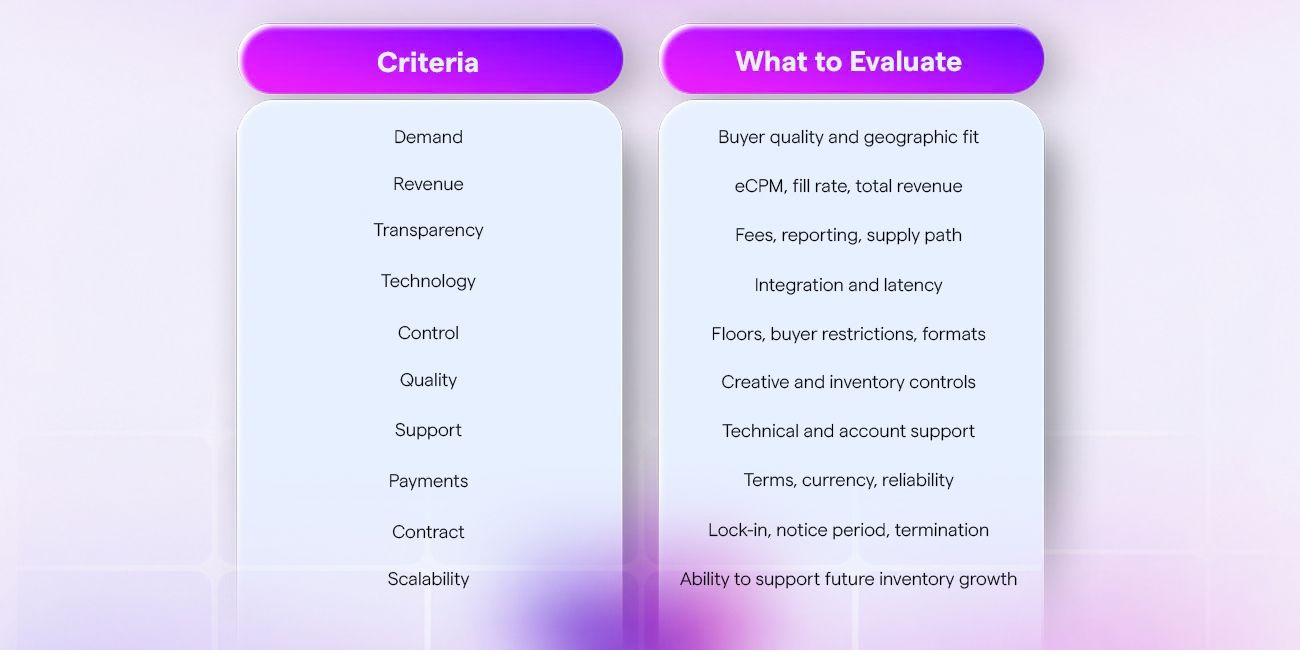
Testing Before Committing
The most reliable way to evaluate a new SSP is to run it alongside the existing setup rather than replacing anything outright. This means testing under the same inventory conditions, measuring more than headline revenue, and checking latency, ad quality, and reporting clarity during the trial period, not just after signing a longer commitment. A platform that performs well in a sales conversation should be expected to perform the same way in a real test. If it does not, that gap is itself useful information.
It is also worth confirming what support looks like during implementation specifically, since integration issues are far more common in the first few weeks than later on. Before signing anything, a short set of direct questions helps close most remaining gaps: which demand sources are actually available for the publisher’s specific geography and format, what happens technically during a timeout, and what the notice period looks like if the relationship needs to end.
Adding a second SSP deserves the same scrutiny as choosing the first one. A new platform is worth adding when it provides genuinely incremental demand, such as access to a geography or format the current setup does not reach well. It is not automatically worth adding simply because it is available. Every additional integration adds auction overhead and operational complexity, and a publisher running several overlapping platforms with duplicated demand can end up managing more complexity without a corresponding increase in revenue.
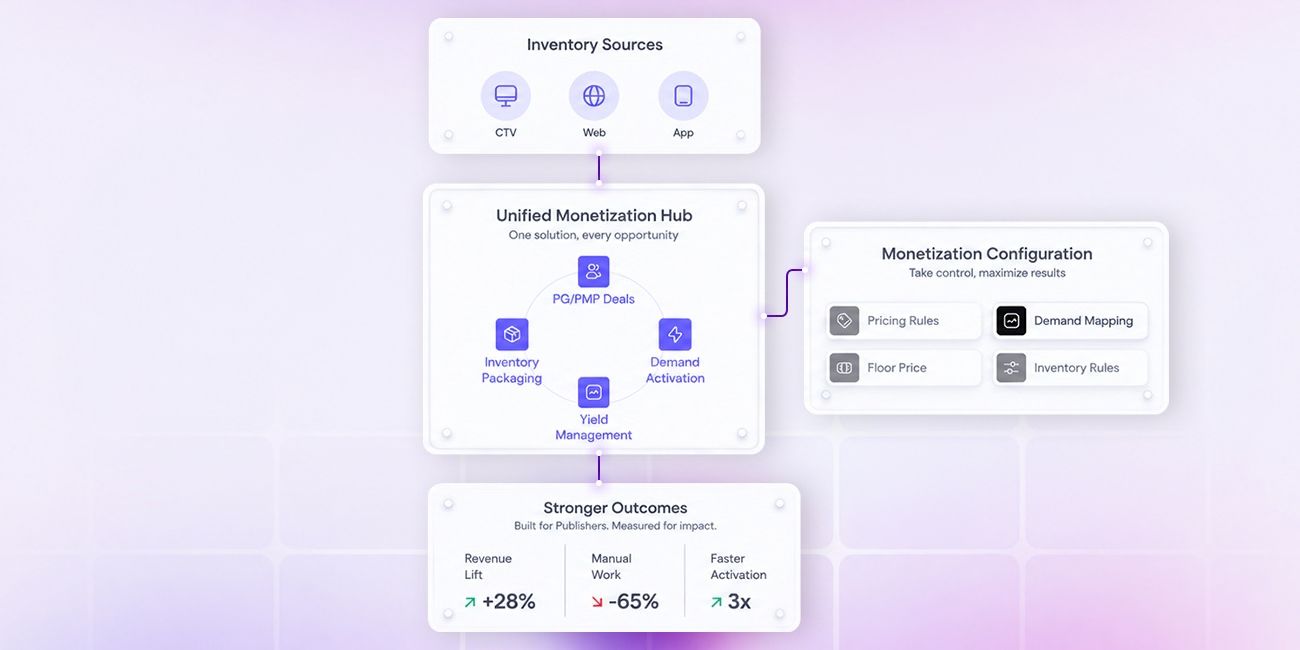
How Helix Applies These Criteria
Helix, a Publisher Monetization Platform and Self-Serve SSP, is a useful example of what these criteria look like in practice, since its design choices map directly onto the evaluation framework above rather than requiring a separate set of questions.
On demand and format fit, Helix runs real-time auctions across web, app, and CTV inventory, giving publishers access to 30+ active demand partners rather than being limited to a single format type. On control, floor pricing is publisher-configurable through zone-level settings, following the same principle covered in the pricing section above: the value is in the ability to test and adjust, not a fixed default. On transparency, publishers can track ads.txt verification and approval status directly from their own dashboard, rather than relying on a separate support channel to find out where things stand. On quality, every publisher and property goes through a manual review step before inventory goes live, which is the same curation principle described in the ad quality section: a platform’s standards for the publishers sharing its demand pool affect every publisher on it, not just the one being reviewed.
None of this means Helix is the right fit for every publisher, the same way no single SSP is. It means that when evaluated against the same scorecard used for any platform, Helix’s specific answers to demand, control, transparency, and quality are concrete and checkable, which is what this framework is designed to surface.
Conclusion
The right SSP is not the one with the biggest demand number on its homepage. It is the platform that holds up against a publisher’s own traffic, formats, technical setup, and commercial expectations when checked criterion by criterion: demand quality, technical fit, pricing and control, ad quality, and commercial terms, confirmed through a real test rather than a sales conversation. A publisher who works through that process consistently ends up with a better answer than one who starts from a list of well-known names.
FAQ
What is an SSP platform?
A supply-side platform, or SSP, connects a publisher’s ad inventory to multiple demand sources through real-time auction, allowing many buyers to bid on an impression at once rather than a publisher negotiating with advertisers directly.
How do publishers choose the right SSP?
By evaluating a platform against their own traffic, inventory formats, technical setup, and revenue goals, rather than by platform size or headline claims. Demand quality, transparency, technical fit, and commercial terms all factor into the decision.
What factors should publishers compare when evaluating SSPs?
Demand quality, format support, supply path transparency, technical integration and latency, reporting depth, floor pricing controls, revenue share and fees, ad quality standards, and contract terms.
Is the SSP with the highest eCPM always the best choice?
Not necessarily. A high headline eCPM can be offset by higher fees, lower fill rate, or poor net revenue reporting. Total net revenue and reporting clarity matter as much as the headline number.
Should publishers work with more than one SSP?
It depends on whether an additional platform provides genuinely incremental demand rather than duplicating existing coverage. Running multiple SSPs can increase competition for inventory, but it also adds operational complexity and auction overhead that should be weighed against the expected benefit.
How can publishers test an SSP before committing? By running it alongside the existing setup under similar inventory conditions, then comparing more than headline revenue, including latency, ad quality, and reporting clarity, before making a longer-term commitment.
Further Reading
Turning Inventory Into Opportunity: A Smarter Approach to Publisher Monetization
Related blogs for you
Industry trends, product updates, and publisher strategies straight from the people building the future of programmatic.